

বাংলাहिन्दी
Store LocatorProblemis that crack on the pillar getting bigger, or is it just my imagination?
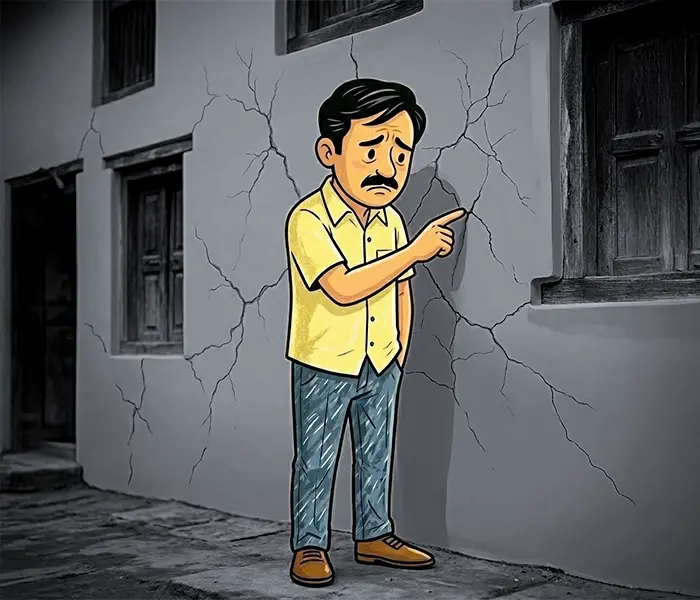
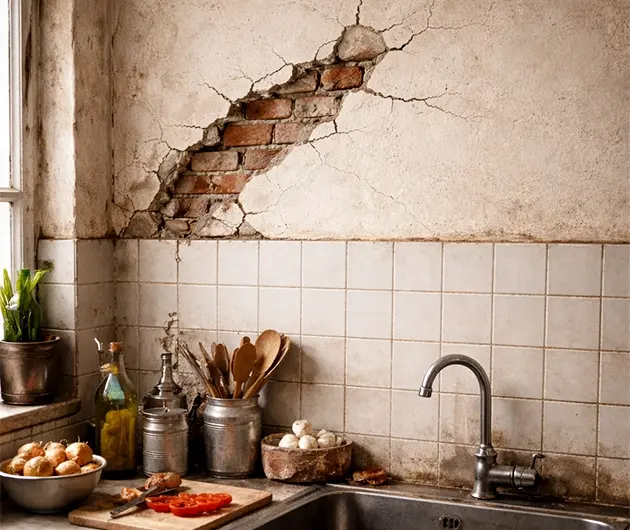
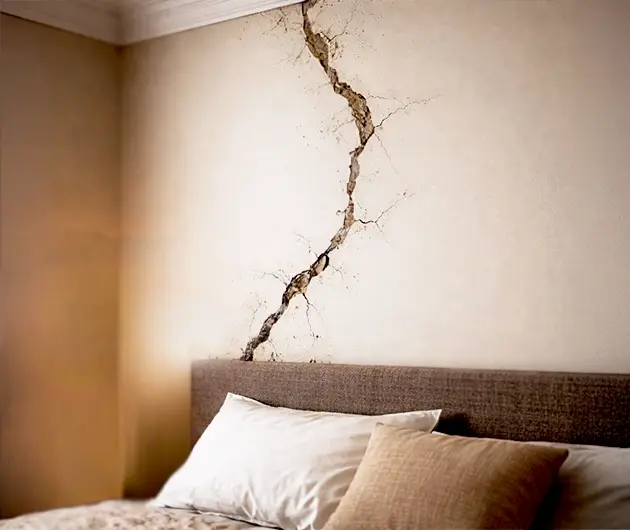
There are few things more terrifying for a property owner, a housing society, or a conscientious builder than watching the physical structure of a building begin to fail. It usually starts with something small: a door that suddenly refuses to close properly, a window frame that seems slightly warped, or a thin, diagonal crack creeping up from the corner of a wall.
At first, you hope it is just the plaster settling. You might ask a local mason to patch it up with some putty and fresh paint. But within a few months, the crack reappears, wider and deeper than before. You start noticing that the floor feels slightly uneven. If the building is an older housing society in Kolkata or a growing district town, the concern is even more pressing. You look at the exposed, spalling concrete on the parking pillars and wonder, "Is this building still safe to live in?
WhyThis Happens?
The Root Causes of Structural Failure.
Buildings do not crack or settle without a reason.
While natural aging plays a role in very old structures, premature structural weakness in new or middle-aged buildings is almost always a result of poor engineering or unverified materials.
Here are the most common mistakes that lead to structural failure:
Uneven Foundation Settlement
Substandard TMT Steel
Incorrect Concrete Mix and Poor Curing
Unauthorized Structural Alterations

The soil beneath your building carries the entire weight of the structure. If the soil bearing capacity was never scientifically tested before construction, or if the foundation was laid too shallow, the building will sink unevenly over time, tearing the walls and beams apart.
If a contractor uses local, unverified TMT bars with low yield stress, the steel cannot handle the immense tension of the building. Instead of flexing slightly under pressure, it stretches permanently or snaps, transferring the deadly load directly to the brittle concrete.
Concrete needs the exact right ratio of cement, sand, aggregates, and water. If a local mason alters this ratio to make the mixture "easier to pour," or fails to cure it with water for the required days, the concrete will never reach its designed compressive strength. It becomes weak, porous, and prone to cracking under its own weight.
Often, during renovations, homeowners knock down interior walls without realizing they are load-bearing, or they add an extra floor that the original foundation was never designed to support.
HowINFRAHUB Solves?
The Engineered Pathway
You cannot fix a structural failure with guesswork. You need the exact same engineering discipline used to build heavy infrastructure. INFRAHUB provides a definitive, scientific pathway to diagnose and secure your building, backed by 25 years of engineering expertise across complex, high-load structures.
- 1
Non-Destructive On-Site Assessment
BUILDING Dr. does not start by breaking walls. A Site Inspection brings structural engineers with advanced Non-Destructive Testing (NDT) equipment. Rebound hammers and Ultrasonic Pulse Velocity meters assess pillars and beams internally, finding hidden voids without causing any damage.
- 2
Scientific Core Testing at INFRA.CLINIC
Where NDT results show severe weakness, physical core samples of concrete and steel are carefully extracted and sent directly to INFRA.CLINIC — NABL- accredited laboratory where concrete cores are crushed and steel is tested in a Universal Testing Machine to determine the exact load capacity of the structure.
- 3
Engineered Remediation Strategy
Instead of a generic chemical, BUILDING Dr. provides a targeted technical specification. For roofs, a UV-resistant elastomeric coating. For bathrooms, tile spacers and epoxy grout to permanently block capillary action. For basements, crystalline self-healing compounds that react with water to block concrete pores.
- 4
Providing the Right Materials
INFRAHUB’s material Hubs supply the exact high-strength repair mortars, structural epoxies, and authentic TMT steel required for the remediation, ensuring your contractor executes the repair flawlessly.
Related Services
Site Inspection & Structural Assessment
Bring BUILDING Dr. to the site for advanced Non-Destructive Testing.
Engineering Consultation
Get a safe, scientifically calculated retrofitting plan.
INFRA.CLINIC Testing
Certify the exact compressive strength of your existing concrete.
Related Products
METALHUB
Procure certified, high-yield TMT bars and premium cement for structural repairs.
See DetailsPROCEMHUB
Access industrial-grade micro-concrete, carbon fiber wraps, and structural bonding epoxies.
See DetailsWATERHUB
Procure certified CPVC, UPVC, and SWR pipes that are guaranteed to handle high pressure.
See DetailsFrequently Asked Questions
Common Questions. Answered Clearly.
How do I know if a crack is dangerous or just cosmetic?
Hairline cracks in plaster are often cosmetic. However, if a crack is wider than a coin, runs diagonally across a wall, appears stair-stepped in brickwork, or is accompanied by doors that no longer close properly, it is a severe structural warning sign that requires immediate engineering assessment.
Will you need to break my walls to test the structure?
Not initially. BUILDING Dr.'s first step is always Non-Destructive Testing (NDT) using ultrasonic waves and rebound hammers. Physical core samples are extracted only if the NDT reveals critical internal failures requiring deeper laboratory analysis.
Can a sinking foundation actually be fixed?
Yes. Through a process called underpinning, engineers can strengthen and deepen an existing foundation to rest on more supportive soil. However, this is a highly complex procedure that must be guided by precise soil testing from an accredited laboratory.
Why should I test my new materials before a renovation?
If you are adding a new floor or doing heavy renovations, you are adding massive weight to an existing structure. Testing ensures the new TMT steel and cement you buy actually possess the strength required to support that extra load without causing the old structure beneath it to fail.